California

Schedule Your Drone Inspection

Professional aerial assessment of your property's exterior condition and wildfire readiness. Every inspection is performed by an FAA Part 107 certified drone pilot.

Request Inspection See what's included
What you'll get: A comprehensive exterior condition review with wildfire readiness observations aligned with the CA Dept. of Insurance Safer from Wildfires program guidelines — plus a structured PDF report, wildfire readiness summary, and full drone media access.
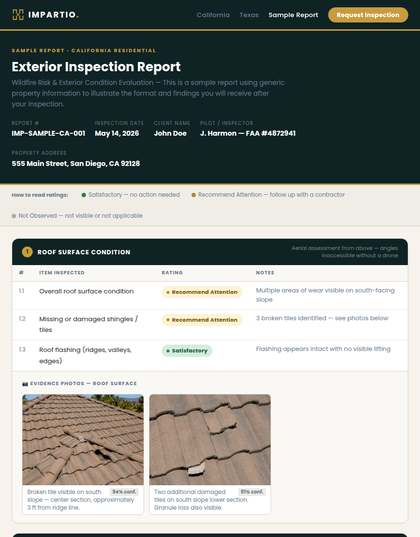
Roof Surface Condition

Aerial assessment of overall roof condition, shingles/tiles, flashing at ridges, valleys, and edges.

General Exterior Observations

Gutters, downspouts, exterior walls, cracks, staining, and general condition documented with drone photography.

Wildfire Readiness Review

Observations on structure hardening and defensible space aligned with the CA Dept. of Insurance Safer from Wildfires guidelines — included in every California report.

Inspection Media Access

All drone photos and videos with a download link. Download before expiration — files will not be accessible after that date.

How It Works

Four steps, start to finish

1

Submit Your Request

Fill out a short form with your property address and contact info. Takes about 2 minutes. No payment required at this step.

2

Sign the Agreement

Review and e-sign the Consent & Service Agreement sent to your email. This authorizes the inspection and confirms your property details.

3

Drone Inspection

A certified pilot conducts the aerial inspection of your property's exterior. No ladders, no climbing, no interior access needed.

4

Report Delivered

Your structured PDF inspection report and drone media download link are typically delivered to your email within 5 days of the drone flight.

Request Inspection

California Wildfire Context

Why wildfire readiness matters

Every California inspection includes observations aligned with the CA Dept. of Insurance Safer from Wildfires program — covering defensible space zones and structure hardening features. These are the recommended guidelines that may help homeowners understand where their property stands and what improvements could reduce wildfire exposure.

Defensible Space Zones (CA PRC §4291)

Zone 0 (0–5 feet) Non-combustible perimeter. State-mandated clearance of all combustible vegetation and materials immediately adjacent to the structure.
Zone 1 (5–30 feet) Lean, clean, and green zone. Tree and shrub thinning, removal of dead vegetation, and spacing of plants to reduce fire spread.
Zone 2 (30–100 feet) Reduced fuel zone. Vegetation management to slow fire spread and reduce flame lengths approaching the structure.

Assessment is visual/aerial only — does not certify compliance with CA PRC §4291.

Structure Hardening Features

What We Observe Ember-resistant vents, enclosed eaves, Class A roofing, non-combustible deck materials, 6-inch base wall clearance, and sealed gaps — the primary defenses against ember and flame intrusion.
Safer from Wildfires (SB 872) California's insurer-facing wildfire mitigation framework. Qualifying structure hardening and defensible space features may make homeowners eligible for insurance premium discounts.

Ready to schedule?

No payment required to submit a request. We'll send the consent agreement to your email.

Request Inspection